

Much of the current conversation around NDIS reform has centred on parental responsibility.
We are told that parents should do more. Families should step in. Communities should help. Informal supports should be strengthened. Foundational supports will fill gaps. Natural supports will provide connection.
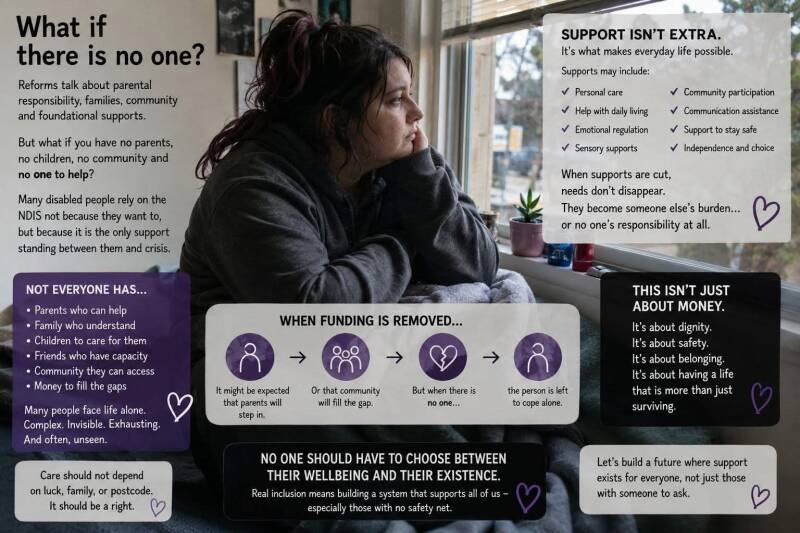
But beneath these conversations is a quieter question. One that screams loudly, continuously, for some.
What if there is no one?
What if there are no parents?
What if your parents have died, are ageing, are unwell, are estranged, abusive, unsafe, absent, or simply unable to provide support?
What if you are the parent?
What if you are the sibling or child who has already spent decades caring?
What if your family relationships are fractured by trauma, poverty, disability, addiction, distance, or circumstance?
What if you do not have children? What if you never will?
What if your friends are also exhausted, disabled, struggling, and trying to survive themselves?
What if "community" is not something you can simply summon from thin air?
The language of informal supports often assumes a safety net exists.
Yet many disabled people know what it feels like to discover that the net was never there.
Or that it has holes.
Or that it was carried by one ageing family member whose shoulders are now beginning to buckle under the weight.
The current reforms increasingly rely on concepts such as family capacity, natural supports, mainstream supports, and foundational supports. On paper, these ideas can sound reasonable. Human beings do not exist in isolation. Relationships matter. Community matters.
But community is not an unlimited resource.
Families are not an unlimited resource.
Love is not an unlimited resource.
And unpaid labour is certainly not an unlimited resource.
For many disabled people, the NDIS was not replacing family support. It was compensating for its absence.
It was recognising that some people have no one available to help them shower, cook, clean, manage appointments, understand paperwork, navigate bureaucracy, recover from burnout, attend the community, regulate through distress, communicate their needs, or remain safe.
When support is removed from an NDIS plan, policymakers may see a budget reduction.
The practical question is where that support goes.
Sometimes it shifts to parents.
Sometimes it shifts to siblings.
Sometimes it shifts to partners.
Sometimes it shifts to community organisations, education or health systems already stretched beyond capacity.
And sometimes there is nowhere for it to go.
Needs do not disappear because funding disappears.
Executive functioning difficulties do not disappear because a support worker is no longer funded.
Sensory overload does not disappear because a support category has changed.
The inability to safely navigate the community does not disappear because a support has been deemed outside the responsibility of the NDIS.
The need remains.
Only the support changes.
The risk is that policy begins to assume an invisible workforce exists to absorb the difference.
Historically, that workforce has largely been families, particularly women.
But what happens when there is no family?
What happens when there is no partner?
What happens when there is no community?
What happens when a person lives alone, ages alone, advocates alone, and struggles alone?
For many disabled people, this is not a hypothetical scenario.
It is their reality.
The conversation about sustainability often focuses on financial sustainability.
That cannot be ignored.
Public systems must be sustainable.
But there is another form of sustainability that receives far less attention.
Human sustainability.
How sustainable is it for ageing parents to provide lifelong care without adequate support?
How sustainable is it for disabled people to navigate increasingly complex systems alone?
How sustainable is it for community organisations, public school and health systems to fill gaps created by system reform without corresponding investment?
How sustainable is it for people to survive on goodwill when goodwill cannot pay rent, provide transport, assist with personal care, or prevent burnout?
The answer is not that families should never help.
Families, friends, neighbours, and communities often provide extraordinary care.
The answer is also not that government should replace every relationship.
Rather, it is recognising that informal supports are a privilege that not everybody possesses.
Some people inherit networks.
Others inherit isolation.
Some people have parents who can advocate, transport, fund, coordinate, and support.
Others have nobody answering the phone.
When disability policy assumes support networks exist, those who are most isolated often become the least visible.
Yet they may be the very people who need support the most.
Perhaps the question we should be asking is not, "Can families do more?"
Perhaps the question is:
"What happens to people when there is nobody left to ask?"
The answer to that question will tell us a great deal about whether our systems are designed around assumptions, or around reality.
Add comment
Comments