

By bee austin
CEO - Gladstone Region Autistic & Neurodivergent Network Inc - GRANN
Every year, photographs appear across social media and news outlets showing CEOs, executives, politicians, and business leaders sleeping on cardboard for a single winter night as part of the Vinnies CEO Sleepout.
Before I say anything else, I want to acknowledge something important: the event raises significant funds for homelessness services. Since its inception in 2006, the Sleepout has raised over $100 million nationally, supporting emergency accommodation, meals, outreach services, and housing initiatives. We do not deny that those services matter. The people working within them matter. The people accessing them matter.
But despite being the CEO of a community organisation, I will not be participating.
Not because homelessness is unimportant. Not because homelessness services do not need funding. Not because I don't care. Quite the opposite.
I won't participate because I have experienced homelessness myself, and I don't believe homelessness can be meaningfully understood through a carefully managed overnight experience.
Homelessness Is Not a Campout: Sleeping outside for one night is uncomfortable.
Homelessness is not discomfort. Homelessness is uncertainty.
It is never knowing where you will sleep next week. It is carrying everything you own because there is nowhere safe to leave it.
It is navigating services while exhausted, traumatised, hungry, ashamed, frightened, and often invisible.
It is being treated as a problem to be managed rather than a person to be supported.
It is the constant cognitive load of survival.
The CEO Sleepout itself acknowledges that participants gain only a small glimpse or "taste" of homelessness. The experience ends in the morning. Participants return home, shower, put on fresh clothes, and resume their lives. People experiencing homelessness do not.
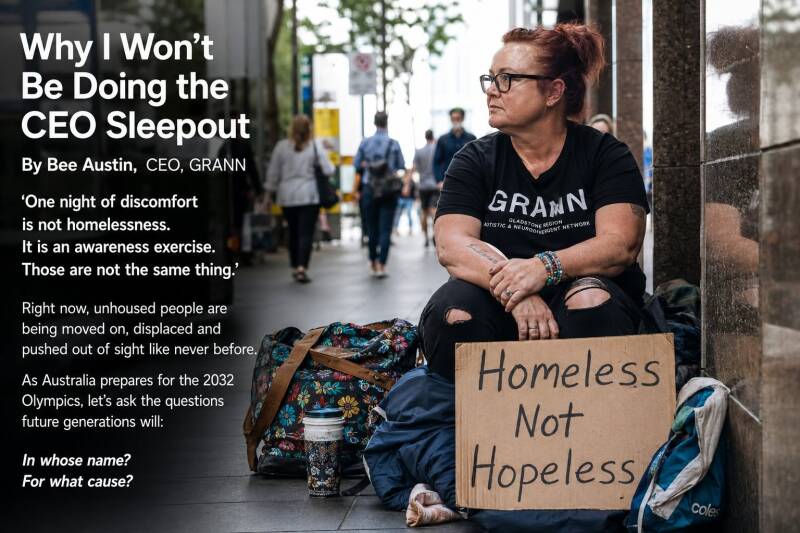
One night of discomfort is not homelessness.
It is an awareness exercise.
Those are not the same thing.
Awareness Is Not Always Action: One of my concerns with awareness campaigns generally is that awareness can become the destination rather than the starting point.
Australia is not suffering from a lack of awareness that homelessness exists.
We know it exists. We know rents are rising. We know affordable housing is scarce. We know people are sleeping in cars. In tents. On the streets.
We know older women are one of the fastest growing groups experiencing homelessness.
We know domestic and family violence remains a major pathway into housing insecurity.
We know all of this already.
The challenge is not awareness. The challenge is political will. The challenge is investment. The challenge is housing supply. The challenge is income adequacy.
The challenge is systems that continue to produce homelessness faster than charities can respond to it.
The Performance of Compassion: The CEO Sleepout sometimes leaves me with an uncomfortable question:
Who is the event really for?
The people experiencing homelessness? Or the people experiencing one night of symbolic homelessness?
The event generates photographs, media coverage, networking opportunities, LinkedIn posts, sponsorship announcements, and public recognition.
For some participants, that visibility undoubtedly helps attract donations.
For others, it risks becoming a form of public performance where compassion is displayed rather than practised.
Most people experiencing homelessness never receive media attention for surviving another week.
Yet a CEO sleeping outside for one night can become front-page news.
There is something worth examining in that contrast.
Even public discussions about the event reveal a tension between those who see it as a valuable fundraiser and those who view it as a form of corporate virtue signalling. Both perspectives contain elements of truth. The money raised is real. The discomfort is real. The publicity is also real.
Out of Sight, Out of Mind: There is another reason I struggle with the symbolism of the CEO Sleepout.
While business leaders spend one night sleeping rough to raise awareness, many people who are actually sleeping rough are increasingly being pushed out of public view.
Across Australia, we are seeing growing tensions around visible homelessness. Camps are being dismantled. People are being moved on from public spaces. Unhoused people are being displaced from areas deemed undesirable, particularly in tourism precincts, commercial centres, and locations where poverty interrupts the image we wish to project.
The timing feels particularly significant.
As Australia prepares to host the 2032 Brisbane Olympic and Paralympic Games, conversations about urban renewal, beautification, tourism, and international reputation are accelerating. History tells us that major global events often come with pressure to make poverty less visible, not necessarily less prevalent.
The question we should be asking is not how homelessness looks to visitors.
The question should be why homelessness exists at all. Because moving people does not house them. Displacing people does not support them.
Making homelessness less visible does not make it disappear. It simply moves human suffering somewhere the rest of us do not have to see it.
Future generations may well look back on this period and ask difficult questions.
How did we accept a housing crisis in one of the wealthiest countries on earth?
How did we normalise people living in cars while investment properties sat empty?
How did we justify removing people from campsites, parks, riverbanks, and public spaces without providing genuine alternatives?
In whose name were these decisions made? For what purpose? For whose comfort? For whose reputation? And who benefited from pushing vulnerable people further into the margins?
History rarely judges societies by how they treated their most powerful citizens. It judges them by how they treated those with the least power.
The real measure of a community is not whether visitors see homelessness. It is whether homelessness exists in the first place.
There Are Better Ways To Help: If I had a spare night and a fundraising goal, I would rather spend it differently.
I would rather: Listen to people currently experiencing homelessness. Fund grassroots peer-led organisations. Support Housing First initiatives. Advocate for more social and affordable housing. Donate directly to homelessness services. Volunteer consistently rather than symbolically. Employ people with lived experience. Pay workers fairly. Challenge policies that create poverty and housing insecurity. Invest in prevention, not just crisis response.
Most importantly, I would centre the expertise of people who have actually lived through homelessness.
People experiencing homelessness do not need simulations.
They need housing. They need income security. They need accessible healthcare. They need community.
They need systems that stop treating housing as a privilege and start treating it as a human right.
What GRANN Believes: At GRANN, we know many Autistic and otherwise Neurodivergent people have experienced housing insecurity, homelessness, couch surfing, family breakdown, family & domestic violence, discrimination, poverty, and exclusion.
We also know that lived experience is knowledge.
Real change rarely comes from spending a night pretending to be vulnerable.
It comes from listening to people who have been vulnerable and lived in vulnerable situations.
So while I genuinely respect those who participate in the CEO Sleepout with good intentions, it is not something I will be doing.
My contribution will continue to be quieter. Less photogenic. Less marketable. And, I believe, closer to the work that actually changes lives.
Because homelessness is not a fundraising theme.
It is not a leadership challenge. It is not a networking event. It is a human experience that nobody should have to endure.
Add comment
Comments