On Investment, Responsibility, and the Future of the Gladstone Region
A statement from GRANN
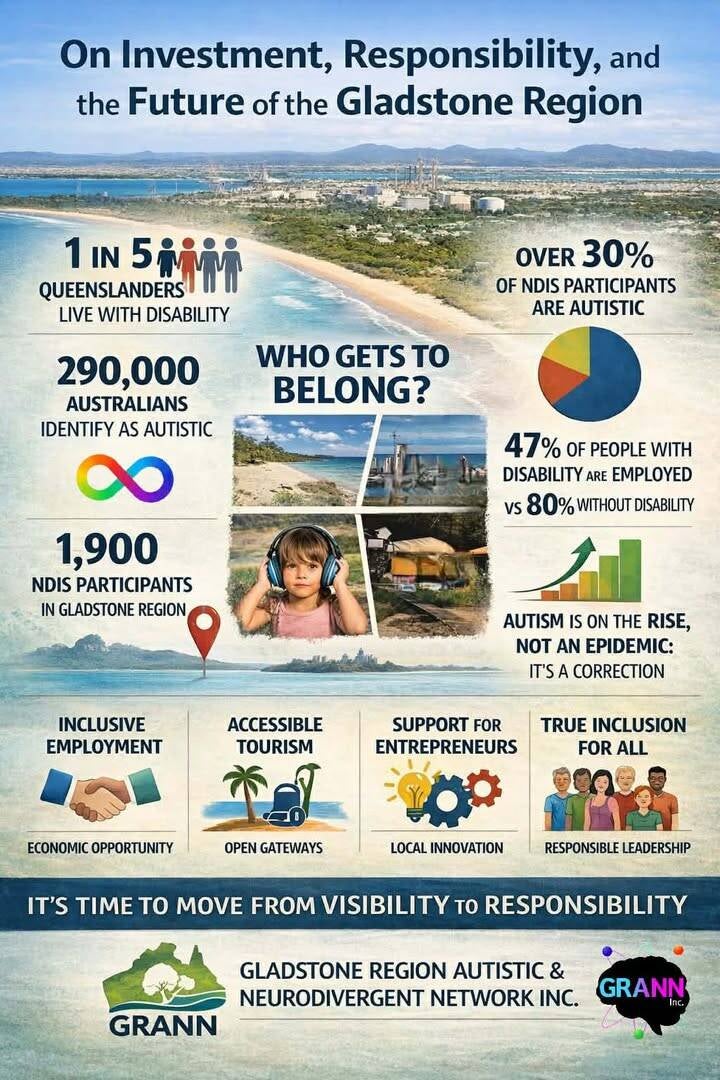
Over one in five Queenslanders, around 1.2 million people, live with disability. Autism alone affects approximately 290,000 Australians and is one of the fastest-rising identified disabilities nationwide. In the Gladstone Region, more than 1,900 people are NDIS participants, with autism the most common primary diagnosis and the majority under 25. Statewide, autistic people make up more than a third of all NDIS participants.
These figures do not reflect a sudden surge in autism. They reflect long-overdue recognition.
Autism identification is rising because entire groups were previously missed, particularly women, gender-diverse people, and adults. Many autistic people are now identified only after their children are diagnosed, when family systems finally begin to recognise patterns that were once dismissed as anxiety, burnout, personality, or failure to cope.
This is not an epidemic.
It is a correction.
Autistic and neurodivergent people have always been here. What has changed is language, visibility, and the courage to name lived reality.
Regional Reality: Seen Too Late, Supported Too Little
In regional and rural Queensland, autistic and neurodivergent people face layered disadvantage. Identification happens later. Services are fewer. Waiting lists are longer. Travel distances are greater. Informal community labour fills gaps left by systems never designed for neurodivergent lives.
In the Gladstone Region, thousands of people require support with communication, sensory processing, executive functioning, mental health, and participation. Most disabilities are invisible, meaning many autistic people navigate workplaces, schools, public spaces, and services without their access needs being recognised at all.
The cost of this invisibility is significant: burnout, unemployment, underemployment, family stress, mental health crises, and people quietly leaving the region to find support elsewhere.
For a region that depends on workforce stability, tourism, and long-term population retention, this trajectory is unsustainable.
Economic Truths We Can No Longer Ignore
Autistic and neurodivergent people are among the most under-employed populations in Australia, despite strengths in systems thinking, innovation, pattern recognition, creativity, precision, and problem-solving.
This is not a failure of capacity.
It is a failure of systems.
National data shows that fewer than half of working-age people with disability are employed, compared with more than 80% of those without disability. Autistic people experience unemployment at more than double the national rate. This exclusion is not only a social injustice, it is an economic loss. Modelling consistently shows that increasing workforce participation of people with disability would deliver billions in economic benefit through productivity, reduced welfare reliance, and increased consumer participation.
In regions like Gladstone, where industry, tourism, small business, and self-employment underpin economic resilience, exclusion is not just unjust. It is economically reckless.
Tourism, Access, and Who Gets to Belong
Gladstone positions itself as a gateway region, to reef, coast, industry, and opportunity.
But a gateway that many cannot pass through is not a gateway.
It is a filter.
Accessible tourism is not niche. It includes families, ageing visitors, people with sensory sensitivities, invisible disabilities, and people who travel with support needs. It also includes locals deciding whether their own region feels welcoming enough to stay.
Investment in accessibility consistently delivers strong economic returns. More importantly, it signals who is valued. True accessibility is not one-off infrastructure or symbolic initiatives. It is consistency, consultation, and follow-through. It is sensory-aware environments, accurate information, trained staff, accessible transport, and inclusive events that do not require people to disclose disability just to participate safely.
Entrepreneurship and Self-Employment: The Missing Investment
For many autistic and neurodivergent people, traditional employment systems are actively disabling. Rigid hours, unspoken social rules, sensory overload, and inflexible performance measures exclude capable people every day.
Entrepreneurship and self-employment are not fallback options.
They are legitimate, powerful pathways.
Across the region, autistic-led microbusinesses, social enterprises, consultancies, creative practices, trades, and digital ventures already exist. Most are under-supported, under-funded, and absent from mainstream economic planning.
Disability policy and regional development strategies rarely include:
- Accessible business development pathways
- Neuro-affirming mentoring and incubation
- Flexible funding models
- Recognition of self-employment as a valid employment outcome
Supporting autistic and neurodivergent entrepreneurship is not charity. It is regional innovation policy.
Where the Gladstone Region Is Falling Short
Despite public commitments to inclusion, lived experience tells a different story.
Consultation with autistic and neurodivergent people is inconsistent and often symbolic. Access planning focuses heavily on physical disability while overlooking sensory, cognitive, and communication access. Regional strategies rely on external organisations rather than building local capacity. Community-led initiatives remain under-resourced while expected to carry systemic gaps. Economic development strategies rarely mention disability at all.
Inclusion cannot sit in a standalone document.
It must be embedded across workforce planning, tourism, housing, transport, education, and disaster preparedness.
When access is optional, exclusion is inevitable.
This Is Not About “Those People”
Disability is not a fringe issue. It is a life-course reality.
If you live long enough, love enough, work enough, parent enough, or survive enough, disability will touch your life.
The question is whether Gladstone chooses to prepare with dignity and foresight, or respond later with crisis and cost.
Call to Action: Moving from Visibility to Responsibility
The evidence is clear. A region that works for autistic and neurodivergent people works better for everyone.
GRANN calls on government, council, business, and community leaders to move beyond visibility toward responsibility, through:
- Genuine co-design with autistic and neurodivergent people across all regional planning
- Investment in local, neuro-affirming supports rather than reliance on distant services
- Inclusive employment, procurement, and leadership pathways
- Dedicated support for autistic entrepreneurship and self-employment
- Accessible tourism that is embedded, not performative
- Clear accountability for inclusion across all portfolios
This is not about special treatment.
It is about building a Gladstone that does not quietly push people out.
Our collective future, economically and ethically, depends on it.